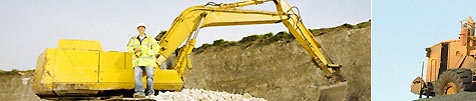
Hydraulic
breakers are powerful, productive machines used to break a variety of
materials. Depending upon the job to be done, the breaker chosen may be
light, medium or heavy. For use, these breakers are to be mounted on
some equipment such as backhoes, excavators etc. Here, these equipment
are called Carriers.
Mechanical Operations
Except lightweight breakers, it is difficult to operate other breakers
by hand as the vibrations transmitted to the operator are very strong
and unbearable. The size of the breaker must match the size of the
carrier. The compatibility of a carrier and a breaker also depends upon
the volume of oil that the carrier can supply and the pressure.
For mounting a breaker hydraulic-installation kit is used which gets
oil flow to the breaker and then brings it back to the machine. In
modern construction industry, a lot of pin-grabbing, quick-coupler
attachments are used on carriers. Quick couplers are clamping devices
that grabs the pins on the top of any attachment. It has the advantage
of hooking up to a variety of attachments without needing to constantly
take out and reposition pins.
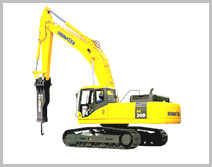
Though the match between breaker and a carrier is essential, it is also
important that the breaker be used appropriately in order for it to
perform as intended.
Applications
As the name suggests hydraulic breakers application mainly lies in
breaking and demolishing big and small constructions. The main functions
of hydraulic breakers are :
- Breaking concrete roads.
- Breaking rocks and asphalt surfaces.
- Trimming of RCC pile heads.
- Concrete demolition projects involving bridge decks, foundations
and pavement.